
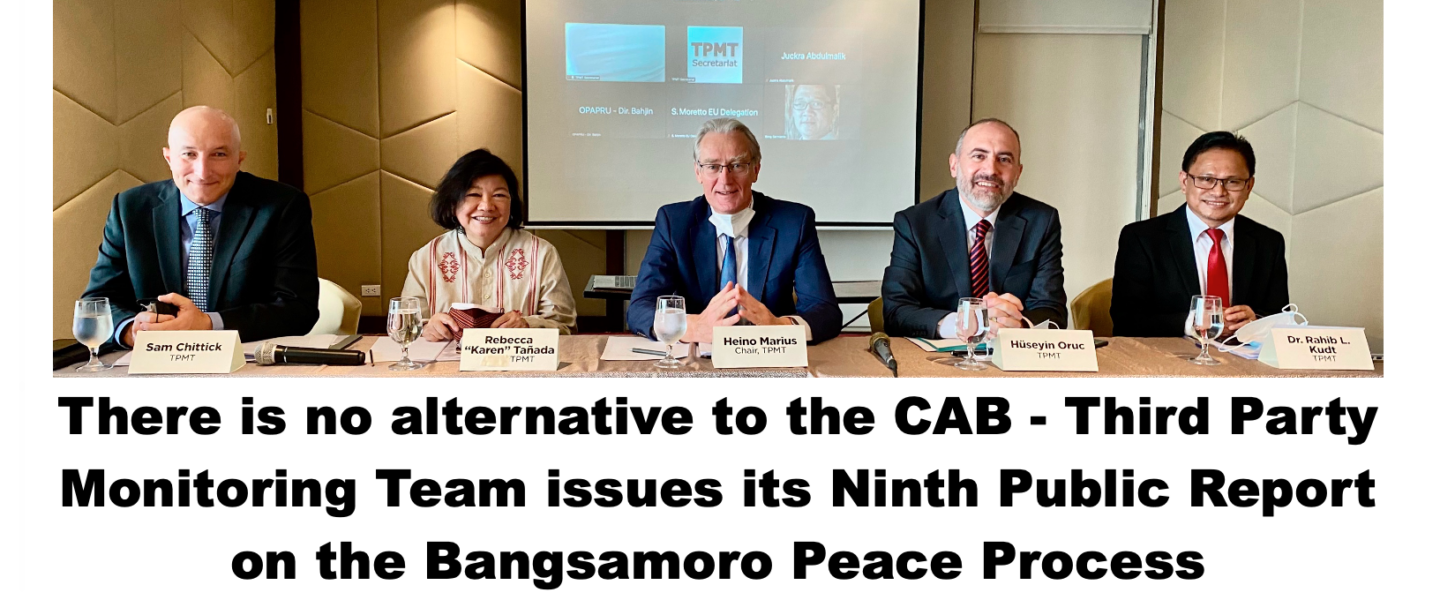
“No Alternative to the CAB”: TPMT Unveils 9th Public Report
 tpmt_admin
May 4, 2026
6 min read
tpmt_admin
May 4, 2026
6 min read
After four postponements, we trust that the first parliamentary elections in the BARMM will take place on 14 September 2026, allowing the citizens of the Bangsamoro to choose their regional representatives. A democratically elected Bangsamoro Parliament will be a formidable achievement of the peace process.
Unfortunately, implementation of the normalization track has fallen behind the political track. While the formal decommissioning procedure has progress through three out of four phases, the provision of socioeconomic support to decommissioned combatants and the transformation of MILF camps has not advanced at the same pace. Other elements of normalization, including recruitment into the police, redeployment of the AFP, disbanding of private armed groups, and transitional justice and reconciliation are still at initial or planning stages.
The CAB set out with the promise of recognizing the legitimate cause of the Bangsamoro People, to chart their political future through a democratic process and to bring lasting peace and stability to the Southern Philippines. These ideals are reflected in core principles of parity of esteem, joint implementation and maintaining the integrity of the peace process. In our assessment these core principles have been compromised all too often over the last few years.
Meaningful self-governance has to be based on decisions grounded in the BARMM. The leadership change in March 2025 affected the balance of power in the Bangsamoro by unilaterally modifying the agreed transitional modalities upon which the peace agreement is based. In preparing for the September 2026 elections, it is important that all stakeholders lend their weight to upholding democratic principles and the sanctity of the electoral process.
Normalization also experienced several examples of unilateral implementation, including the suspension of decommissioning, discontinuation of the International Monitoring Team and the introduction of the localized normalization initiative approach. The future of the peace process depends on whether the Parties through the Peace Implementing Panels can revitalize the delivery mechanism of the CAB based on a united and determined approach.
As we approach the September elections and the end of the transition phase, we call on both Parties to demonstrate continued commitment to the implementation of the CAB. It is particularly important to uphold mutual respect as a core value. Trust which has been built over years is very easy to destroy but difficult to rebuild. It has to be continuously nourished.
The CAB represents a negotiated political settlement to resolve the Bangsamoro Question once and for all with honor, justice and dignity. For the sake of lasting peace in the Southern Philippines, there is no alternative to the CAB. Whatever the outcome of the elections, we appeal to all political stakeholders in the BARMM and in Manila to maintain commitment to the implementation of the CAB until all objectives of the peace process have been achieved.
The TPMT proposes the following key recommendations:
· In advance of the first regional elections in the BARMM, clear communications and mechanics/actions that ensure free and fair election, and respect for the results, will be critical to safeguard the democratic process.
· The most important task is to rebuild trust between the Parties. It is essential that they reaffirm their commitment to the letter and spirit of the CAB, in word and in deed. Core implementation principles of the CAB, in particular parity of esteem, taking steps jointly and nurturing the integrity of the whole peace process deserve to be honored. It is crucial for the Parties to revitalize the common CAB narrative.
· As the political track nears completion, the normalization track has only been partially implemented. This requires a continued prominent role for the Peace Implementing Panels. They need to have the mandate and the authority to directly oversee the implementation of the normalization track. We recommend that they meet frequently and regularly. Any remaining uncertainty over the provision of socioeconomic support for decommissioned combatants and camps transformation should be resolved.
· Adjustments and refinements in implementation methods and coordination structures may be required. Any changes in the management of the peace process should be founded on mutual agreement by the Parties. Unilateral implementation undermines confidence in the peace process.
· President Marcos Jr. is in charge of providing overall policy direction in the conduct of the nation’s comprehensive peace process. We suggest regular high-level engagement between the President and the MILF leadership. In order to reinforce and strengthen the role of the Panels, we recommend that the GPH Panel should report directly to the Office of the President, thereby confiding in the authority and the institutional backing of the President.
· Applications for amnesty by MILF combatants have developed considerable momentum lately, but the deadline for applications already expired in March 2026. We support an extension of the application period by another year to encourage more interested persons to come forward. Actual granting of amnesties should be accelerated.
· The TPMT welcomes agreement on a GPH-MILF Transitional Justice and Reconciliation (TJR) Roadmap and approval by the Bangsamoro Parliament of the Bangsamoro TJR Program. A regional initiative can complement but not substitute for a national TJR mechanism. Progress on TJR at national level remains an urgent priority.
· We call on civil society, private sector and international peace partners to stay strongly engaged in the Bangsamoro and at national level in actively supporting the continued implementation of the peace process.
· The TPMT encourages the Parties to conclude an Exit Agreement before the term of the current Administration comes to an end. We believe this is still possible. For this to happen, the Parties will need to engage in focused dialogue and strategic review to define a clear Roadmap for completing the normalization track, including a timeline and funding commitments for the coming years. The chance to complete the substantial implementation of the CAB is a golden opportunity for the Philippines, a once-in-a-lifetime opportunity to hand to future generations a more peaceful and prosperous Bangsamoro region, and country.
Type your paragraph here